Showing posts with label Crustacean. Show all posts

King crab


The Life of Animals | King crab | Golden king crab, Lithodes aequispinus, is captured on the coast of Alaska in the Aleutian chain. Gold king crab is significantly smaller than the king crab red and blue, about 5-8 pounds (2.3 to 3.6 kg). It tastes like the red and blue king crabs, though perhaps sweeter. Note to occur in waters deeper than red king crab, often in the depths of 300 miles (1,800 feet, 550 m). Crabs king's golden youth are intricate and confidence in the structure-forming sessile invertebrates growing on the seabed like corals, sponges, sea whips provide Habitat. Habitat is the main factor that separates the range of red and blue king crabs in the Bering Sea.


Red king crab, Paralithodes camtschaticus, is a large species, reaching a thickness of 11 heavy shells (28 cm) and a leg extension 6 feet (1.8 m). Its natural range is the Bering Sea, the Aleutian Islands and St. Lawrence Island. You can now also in the Barents Sea and Arctic Europe, where it is drawn, and now it has become a plague of blue king crab, Paralithodes platypus, lives near St. Matthew Island, Pribilof Islands, and the Diomede Islands, Alaska and they are the people of Japan and the Russian king crab from Pribilof Islands are the largest of all king crab, sometimes more than 18 LB (8 kg) weight.

Hermit Crab


The Life of Animals | Hermit Crab | Most species have long, spirally curved abdomens, which is soft, unlike the hard, calcified abdomens appear in crustaceans. Protected from predators by a salvaged empty seashell Hermit Crab wounded abdomen, where the whole body back. The top of the abdomen is adapted to clasp strongly onto the columella of Cancer hermit snail shell. HERMIT CRAB, as its size increases, it becomes the shell find a large, and not before. The habit of living, but the shell gives the popular name "hermit of Cancer", by analogy with the hermit, who lived a few Hermit Crab species, and land and sea, as "vacancy chain" of the new BUZZ When new, the clay is, hermit crabs collected and formed of all the surrounding him from the modes of the greatest to the least. Cancer Cancer is brought to the maximum with the shell, the maximum time it was published before the new shell is the shell of Cancer,


Hermit Crab species range in size and shape, a species with a few heavy shells religious brevimanus mm long, can live 30-70 years and were approaching the size of a pain. Shell-less hermit Cancer Birger robber (Coconut Crab) This is a terrestrial invertebrates. Hermit Crab zoea larvae hatch, especially in the third stage. Many marine species of hermit crabs is common in the marine aquarium trade. Nearly 15 species of terrestrial world, the following are commonly kept as a concern: Caribbean Hermit Crab (religious and shielded), the Australian land hermit Crab (religious variable) and the Ecuadorian Hermit Crab (religious compressed).

Yeti Crab


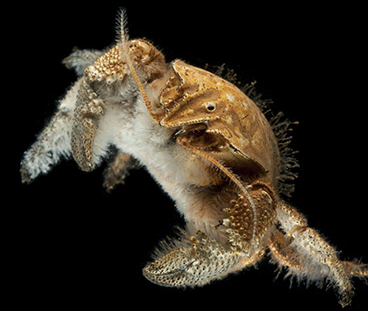
The Life of Animals | Yeti Crab | K. hirsuta was discovered in March 2005, a group organized by Robert Vrijenhoek of the Monterey Bay Aquarium Research Institute in Monterey, Calif. And Michel Segonzac of the Ifremer and the Census of Marine Life scientist's use of the submarine DSV Alvin, operating from RV Atlantis. The discovery was announced March 7, 2006. Hairy pincers contain filamentous bacteria, which the creature can be used to neutralize toxic minerals from the water emitted by the hydrothermal vents, where he lives.


The term "furry lobster" is usually used for family Synaxidae. McPherson et al. Named the genus Kiwa after "goddess of shellfish in Polynesian mythology," but it is the sea in Maori mythology Kiwa Guardian Hirsuta means "hairy" in Latin.

Woodlouse

  
The Life of Animals | Woodlouse | The woodlouse has a shell-like exoskeleton, the which it must progressively shed as it grows. Metabolic rate is temperature-dependent in woodlice. Woodlice need moisture Because They rapidly lose water by excretion and through Their cuticle, and so are usually found in damp, dark places, Such as under rocks and logs, although one species, Hemilepistus reaumuri, inhabits "the driest habitat conquered by any species of crustacean ".

Prawn

  
The Life of Animals | Prawn | Together with other swimming Decapoda, Dendrobranchiata show the "caridoid facies", or shrimp-like form. Generally the body is slightly flattened side-to-side. The biodiversity of Dendrobranchiata decreases markedly at Increasing Latitudes most species are only found in a region of the between 40 ° north and 40 ° south. Some species may occur at higher latitudes.

Lobster


The Life of Animals | Lobster | Lobsters are invertebrates with a hard protective exoskeleton. Like most arthropods, lobsters must molt in order to grow, the which leaves Them Vulnerable. Although, like most other arthropods, lobsters are largely bilaterally symmetrical, They Often possess unequal, specialized claws, like the king crab. The lobster's head bears the antennae, antennules, mandibles, the first and second maxillae, and the first, second, and third maxillipeds. Because lobsters live in a murky environment at the bottom of the ocean, They Mostly Their use antennae as sensors. The lobster eye has a reflective structure above a convex retina.

Crab


The Life of Animals | Crab | Generally Crabs are covered with a thick exoskeleton, and armed with a single pair of chelae (claws). Crabs are found in all of the World's Oceans, while many crabs live in fresh water and on land, particularly in tropical regions. Crabs Vary in size from the pea crab, A Few millimeters wide, to the Japanese spider crab, with a leg span of up to 4 meters (13 ft). About 850 species of crab are freshwater, terrestrial or semi-terrestrial species They are found throughout the world's tropical and semi-tropical regions.

Post Labels

Albatross Alligator Amphibian Anteater Antelope Ape Armadillo Aves Avocet Axolotl Baboon Badger Bandicoot Barb Bat Bear Beaver Bee Beetle Beetle Horns Binturong Bird Birds Of Paradise Bison Boar Bongo Bonobo Booby Budgerigar Buffalo Bugs Bull Butterfly Butterfly Fish Caiman Camel Capybara Caracal Cassowary Cat Caterpillar Catfish Cattle Centipede Chameleon Chamois Cheetah Chicken Chimpanzee Chinchilla Cicada Cichlid Civet Clouded Leopard Clown Fish Coati Collared Peccary Common Buzzard Cougar Cow Coyote Crab Crane Critically Endangered Crustacean Cuscus Damselfly Deer Dhole Discus Dodo Dog Dolphin Donkey Dormouse Dragon Dragonfly Duck Dugongs Eagle Eastern Rosella Echidna Eel Elephant Emu Extinct Falcon Fennec fox Ferret Fish Flamingo Flatfish Flounder Fly Fossa Fox Frog Gar Gazelle Gecko Gerbil Gerridae Gharial Gibbon Giraffe Goat Goose Gopher Gorilla Grasshopper Green Anaconda Guinea Fowl Guinea Pig Gull Guppy Hamster Hare Harp seal Hawk Hedgehog Heron Hippopotamus Horse Hummingbird Hyena Ibis Iguana Impala Insect Invertebrate Jackal Jaguar Jellyfish Jerboa Kangaroo Kestrel Kingfisher Kiwi Koala Komodo Kowari Kudu Ladybird Ladybug Larvae Lemming Lemur Leopard Liger Lion Lizard Llama Lobster Loris Lynx Macaque Magpie Mammoth Manta Ray Markhor Marsupial Mayfly Meerkat Mermaid Millipede Mollusca Mongoose Monkey Moorhen Moose Mosquito Moth Mule Near Threatened Newt Nightingale Nudibranch Numbat Octopus Okapi Omnivore Orangutan Oriole Ornamental Birds Ornamental Fish Ostrich Otter Oyster Pademelon Panda Panthera Parrot Peacock Pelican Penguins Phanter Pig Pika Pike Platypus Polar Bears Porcupine Possum Prawn Primate Puffer Fish Puffin Puma Quoll Rabbit Raccoon Rare Rat Reindeer Reptile Rhino Robin Rodent Salamander Salmon Scorpion Scorpion Fish Sea lion Sea ​​horse Seals Serval Shark Skunk Snake Squid Squirrel Starling Bird Stoat Stork Swan Tapir Tarantula Threatened Tiger Tortoise Toucan Turtle Vulnerable Vulture Walrus Warthog Weasel Wildebeest Wolf Wolverine Wombat Woodlouse Woodpecker Zebra crocodile east Concern moles ntelope owl spider whale

Blog Archive