Showing posts with label Reptile. Show all posts

Kemp's Ridley Sea Turtle


The Life of Animals | Kemp's Ridley Sea Turtle | Ridley sea turtles generally prefer hot water, but they live in the water as far north as New Jersey, in the Gulf of Mexico and Florida, often migrate to live in the waters of Louisiana. The range includes the Atlantic Ocean and the Gulf of Mexico.  Then, in the northwest Atlantic and Gulf of Mexico runs as they grow to maturity. These turtles change color as they mature. The breeding season for these turtles is April to August They nest primarily in the Mexican state of Tamaulipas, but sometimes the Father Iceland, Texas, United States. The estimated number of women nesting in 1947 was 89,000, but dropped to about 7702-1985 Women nest three times during the season, from 10 to 28 days between clusters. Incubation lasts 45-70 days. There are, on average, about 110 eggs per clutch.


At least one source also refers to Kemp "turtle grief." In his book The Rescue largest Ridley, Pamela Philips argued the names of fishermen, turtles die after "turned turtle" was observed (rear) embossed. Kemp Ridley Mexico protected the first time in 1960. United States was the first under the Endangered Species Conservation Act Kemp 1970 December 2, 1970 is included, then under the Endangered Species Act (ESA) in 1973. One of the mechanisms used to protect turtles in fishing nets, the turtle excluder device (TED). Since the greatest threat to the population of Kemp Ridley sea turtles are shrimp, connect your device to the shrimp trawl.


In September 2007, Corpus Christi, Texas, wildlife officials found a record 128 Kemp's ridley sea beaches Ridley nesting in Texas, including 81 in North America Padre Iceland (Iceland Padre National Seashore) and four officials Iceland fauna Wild Mustang released 10,594 Kemp Ridley babies along the Texas coast this year. Turtles are popular in Mexico as boot material and food. The Deepwater Horizon oil spill threatens a wide variety of marine life, dolphins blue crabs. April 30, 2010, 10 days after the accident on the Deepwater Horizon, 156 dead sea turtles have been reported, most were Kemp Ridley. Louisiana Department of Wildlife and Fisheries biologists and security guards have rescued Kemp Ridley in Grand Isle


Threatened marine species that frequent the Gulf, only the Kemp's ridley is based on the region as a single pool. The general plan is to collect about 70,000 eggs in the nests of sea turtles on the beaches of Alabama and Florida before you swim, and slip into the Deepwater Horizon explosion Louisiana.
Find The Life of Animals

Green Anaconda


The Life of Animals | Green Anaconda | The green anaconda is the longest snake in the world, reaching more than 6.6 meters (22 feet) long. It is the largest snake native to the Americas and flaky probably the largest species of snakes or electricity. Although the reticulated python is longer, the anaconda is the heaviest cut pipe with a 4.5 7.4 m higher green anaconda python. The longest and heaviest () scientifically analyzed samples was a woman 521 cm (17.09 feet) long and weighs 97.5 kg (215 lb). The remoteness of the snake habitat is found historically difficult to collect and return samples. The large sample transport museums, particularly the sharp decline, it is difficult (but not the return of the much larger and heavier crocodilian specimens occur). Reports observing animals that are not shown, are always questionable, as even trained scientists often overestimated the size of anacondas before recording. For more information, visit those who live in the periods under the pressure of the population longer, up to larger sizes. There are many historical accounts of green anacondas often ridiculously improbable sizes. Many zoologists (notably Henry Walter Bates and Alfred Russel Wallace, etc): Please note that the rumors of snakes by 30 or 40 yards, but in any case, direct observations of snakes by 20 feet long were limited.


Almost all samples over 6 m (20 ft), including a critically acclaimed shows of 11.36 m (37.3 feet) long, no copies, including the skin and bones. Herpetologist while measured in Colombia in 1978, William W. Lamar met with a large sample of women, 7.5 meters (25 ft) and weigh approximately 136-180 kg (300,400 pounds). With a maximum circumference of 112 cm (3.67 feet) from a woman claiming 7.9 m (26 ft) long, shot in 1963 in the Nariva Swamp, Trinidad, with 1.5 m (4, 9 feet ) crocodile. If the sample (19.5 ft), 5.94 m long, weighed 91 kg (200 lb). The approximate weight of an anaconda of 8 m (26 ft) of at least 200 kg (440 lb). Weight varies considerably, large samples, depending on the environment and feed the latter is in the previous example Verrill After very large, reduced to 163 kg (360 lb), while another copy is too large, to 5.06 m (16 ft 6 in) weighs only 54 kg (120 lb). In 10th Edition of the famous Systema naturae 1758, Carl Linnaeus cited descriptions and Laurens Albertus Seba Theodore Gronovius Boa various murine build his new gender, eight other species, including Boa constrictor.


The first examples were immature murine Boa is 2.5 to 3 m (75 to 90 cm) long. In 1830, Johann Georg Eunectes Wagler same sex "good swimmer" Boa murina Linnaeus for further samples were known and described. Since the male from the female-specific murine Eunectes murinus renamed America. Serpens American testudinacea murium insidiator" turtle pattern (spotted) American slang, a predator lurking in mice and rats murinus The Latin adjective (murine) in this case means "mouse" or "mouse connected" refers to "change his spots" and not "gray mouse" that people often do not display correctly for E. murinus. Early English-based sources, such as George Shaw, the murine Boa as "rat boa" and Penny Cyclopaedia (Vol. 5) entry for Boa said: "The common name implies, in the Waiting for some mice, mice found rufus maculis rotundatis up." red-brown "Boa appearance of murine Latin Linnaeusdescribed". Rounded spots at the top] and not gray on the description of the colors green anaconda immediate names refer others by various authors on the general brown, blue, green or gray. Popular names for Eunectes murinus include Green Anaconda, Anaconda, Anaconda boa common water.


Local names in South America, the Spanish term mata-bull, meaning "bull killer" and Native American words Sucuri (Tupi) and yaqumama in the Peruvian Amazon, the "Mother of Waters" Quechua language of the people in the jungle Yaqurunas or " water people ". Anacondas often men push the tongue, that the presence of the chemical signal wife Many men are often the same woman. This ball is like a wrestling match between idle men, fighting for every occasion. Women with During mating, males use their spurs in the female generation. They display their aggressive campaign against the woman's body while scratching his footsteps. Mating approaches its climax when males stimulus spurs cause female snake their cloaca to increase the area of the cloaca to move two tubes. The men coils its tail with the female and her mate. The strongest man and is often the biggest winner. However, women are physically bigger and stronger, and may decide to choose between men. Courtship and mating occur almost exclusively in the water.
Find The Life of Animals

Flying Snake


The Life of Animals | Flying Snake | Chrysopelea also below their assigned common name "flying snakes" known. He slides his balance comb over his belly and slid against the rough bark of tree trunks, making up a tree. The combination of sucking in your stomach and make a lateral move to the curve in the air makes the snake can float in the air, which can save energy from the earth and terrestrial predators Dodge limited concave bearing surface that creates long journey suction snake flattens the stomach body to twice the width of the back of the head to the anal hole is near the end of the tail of the snake, making the cross section of the body of the snake resemble sectional through a cross Frisbee or flying saucer.


When a flying disk revolutions in the air, resulting in increased projecting section concavity air pressure to the center of the disc, to raise the flying disc. A snake is continuously moved in lateral undulation for the same effect of increasing the air pressure below the arcuate body to create a slide. Flying snakes are able to glide better than flying squirrels and other gliding animals, despite the absence of limbs, wings, wing extensions or other, glide through the forest and jungle life with a distance as great as 100 m. There are five recognized species of flying snake, found in western India Indonesian archipelago.


It is a bit poisonous snakes ", but its small and fixed rear teeth that make them dangerous to humans Golden tree snake or ornate flying snake, adorned Chrysopelea (Shaw, 1802) This result is the largest species of snake fly, up to four meters long. Although it is the golden tree snake, there are other colors, for example, tend to have a few steps toward the thin lime green pure yellow, while in India, the IT-orange red marks and small black bars back, rich colors almost paradise tree snake. Paradise tree snake, Paradisi Chrysopelea Boie and Boie, 1827 This species of flying snake fields of up to three meters long and is very popular in the pet trade in Europe. Their bodies are black, but covered with rich green scales. Tree Band snake or flying serpent, Chrysopelea Pelias (Linnaeus, 1758) Twin-Lock: This is the smallest species of flying snakes up to two meters long. Though small, it is certainly one of the rarest species of flying snakes in the range.  

Find The Life of Animals

Lizard Sailfin


The Life of Animals | Lizard SailFin | Malaysian Sail finned Lizards grow 0.9144m (3 feet) in length. These lizards have a small head with a long snout and nose oval near the tip of the snout. In the head and the muzzle is usually a top of some large scales and small scales. Fingers and toes have lobes of skin. The Sail finned Lizards characteristic is only the tail, which is twice the length of the head and body together.


The flattening of the tail helps the lizard swim. They are stocky lizards that are dark green-brown with black spots. These lizards are found in Indonesia, New Guinea, Philippines. Young people can be found in ditches and around people. The lizard males are combative and competitive against other males when trying to court the females.


Browse fins Lizards feed mostly on plants, but also are known for insects, rodents and millipedes eat, people eat prey is worth 60% and 40% of the plants. Amboinensis lives Hydrosaurus 15 years or more.

Uromastyx


The Life of Animals | Uromastyx | Their size varies from 25 cm (10 inches) (U. macfadyeni) to 91 cm (36 inches) or more (U. aegyptia). Newborn or young animals are usually not more than 10.7 cm (4.3 inches) in length. Like many other reptiles, lizards, these "colors change with temperature, while the cool weather they appear dull and dark, but the colors are brighter on hot days, especially when heated, allowing the darker pigmentation of their skin to absorb the sunlight effective. Uromastyx inhabit a range extending across North Africa, the Middle East and extends into south-central Asia and India. A female Uromastyx can be anywhere 5-40 eggs, depending on the age and species. Wild female Uromastyx are smaller and less colorful than the males. For example, females may be maliensis often light brown dorsally, with black spots, while males are mainly bright yellow speckled with black spots. Women also tend to have short nails caught maliensis may tend to imitate females, the men of color.


Enter a Uromastyx to lead a bowl of water to a higher humidity in the cage and can cause problems for the animal. Uromastyxs captive diets should be "vegetarian herbivorous, mainly consisting of endive, dandelion, bok choy and escarole. lizards need food with a calcium supplement and a Uromastyx designed to prevent health problems can be dusted off. is very important to avoid Chard cabbage, spinach and flowering plants in all diets reptiles, as oxalates prevent spinach uptake of calcium into the bloodstream. should not insects to a Uromastyx. Historically, captive Uromastyx had a poor survival rate because of the lack of understanding of their nutritional needs and environmental concerns.


The Mali Uromastyx (Uromastyx maliensis) is considered ideal to choose species as pets because they adapt easily to captivity. Another species of Uromastyx that adapts itself well to captivity and comes in a variety of colors, is Uromastyx ocellata ornata. UVB light / UVA artificial vitamin supplements and should be balanced with the food and nutrition, is the UVB light necessary for the absorption of calcium from the intestine. Although lizards very high heating temperature, a temperature gradient within the enclosure so that they have to cool down the heat lamps. The temporary slowing of the metabolism also increases the life expectancy of the animals.

Spiderman Agamas

  
The Life of Animals | Spiderman Agamas | The Mwanza Flat-headed religion or Mwanza Flat-headed Rock Religion (Religion mwanzae) is a species of lizard from the family Agamidae, found in Tanzania, Rwanda, and Kenya. The male's head, neck and shoulders are bright red or violet, while the dark blue body. The female is mostly brown and is difficult, to distinguish from other female agamas. This species is Often confused with the Red-headed Rock Religion (Christian religion).

Kleinmann's tortoise

  
The Life of Animals | Kleinmann's tortoise | Kleinmann's Tortoise is the smallest tortoise in the northern hemisphere Female tortoises are larger than the males males are more Slender and have a longer tail. Their shells have high domes, and range in color from ivory to pale gold to dark brown or dull yellow. This allows the paler tortoise to stay in the desert heat for longer. The tortoise's scutes have dark sidings That fade with age. The head and Limbs are a very pale ivory-yellow to Yellowish-brown color.

Indian star tortoise

  
The Life of Animals | Indian star tortoise | Carapace very convex, dorsal shields Often forming humps Nearly vertical lateral margins posterior margin somewhat expanded and strongly serrated; no nuchal supracaudal undivided, incurved in the male shields strongly striated concentrically first vertebral longer than broad, the others broader than long third at least as broad as the corresponding costal. Head moderate forehead swollen, convex, and covered with rather small and irregular shields; beak feebly hooked, bi-or tricuspid; edge of jaws denticulated alveolar ridge of upper jaw strong.

Desert tortoise

  
The Life of Animals | Desert tortoise | This tortoise may attain a length of 10 to 14 inches (25 to 36 cm), with males being slightly larger than females. Male tortoises have a longer gular horn than females, Their Plastron (lower shell) is concave compared to female tortoises. Desert tortoises can grow from 4-6 "(10-15 cm) in height and weigh 8-15 lb (4-7 kg) fully grown. The tortoise is Able to live where ground temperature may exceed 140 degrees Fahrenheit (60 degrees Celsius) Because of its ability to dig underground Burrows and escape the heat.

Aldabra giant tortoise


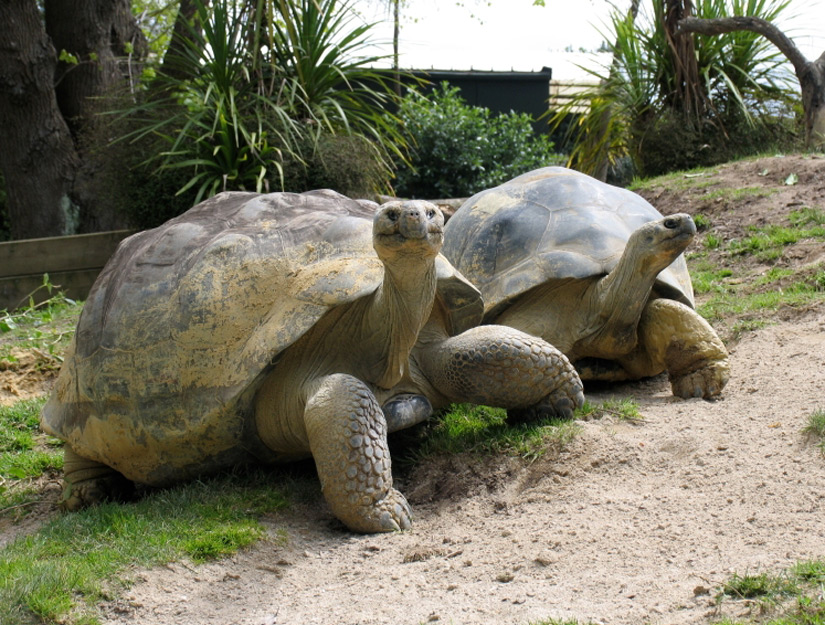
The Life of Animals | Aldabra giant tortoise | Adwaita's was determined by carbon dating his shell, making his age to be around 255 in 2006 Today, Esmeralda is thought to be the oldest giant tortoise living at 170 years old, since the death of Harriet at 176, a giant Galapagos tortoise. Esmeralda is an Aldabra giant tortoise. Females can Produce multiple clutches of eggs in a year. In captivity, oviposition dates Vary. Tulsa Zoo maintains a small herd of Aldabra tortoises and They have reproduced Several times since 1999. The zoo also incubates Their eggs artificially, keeping two separate incubators at 81 degrees F and 86 degrees F.

Galapagos Tortoise


The Life of Animals | Galapagos Tortoise | The Galapagos tortoises, like most other species of tortoise, is a herbivores spending its time grazing on grass and low trees. The Galapagos tortoise is a very quiet, peaceful and lazy animal with the Galapagos tortoises waking up early in the morning to Basque in the sun until the enormous body of the Galapagos tortoise has warmed up.

Gharial

  
The Life of Animals | Gharial | The average size of mature gharials is 3.5 to 4.5 m (11 to 15 ft). Young gharials can reach a length of 1 m (3.3 ft) in eighteen months. Males attain a body length of 3 to 6 m (9.8 to 20 ft), while females are Smaller and reach a body length of 2.7 to 3.75 m (8.9 to 12.3 ft).  Male individuals of up to 6 meters (20 ft) were the resource persons commonly encountered in the past, but large Such individuals are unknown today. Their well-developed laterally flattened tail and webbed rear feet Provide Tremendous Their maneuverability in deepwater habitats. On land, however, an adult gharial Itself can only push forward and slides on its belly. Its elongated, narrow snout Becomes Thicker proportionally shorter and as an animal ages. The bulbous growth on the tip of a male's snout renders gharials the only visibly sexually dimorphic crocodilian. This growth is present in mature individuals and ghara Called after the Indian word meaning "pot". The Nepali word means घड़ा ghaṛā earthenware pots, pitchers, watervessel.

Bearded Dragon


The Life of Animals | Bearded Dragon | The genus is in the subfamily Agaminae of the family Agamidae. The species also displays a hand-waving gesture, this submission is to show the between Dragons. There are cases where a female has a bigger head and tail than her male counterpart. Mature males Will Turn Their throat pouches (beards) black During courtship to signal dominance, although females have also been known to do the same.

Caiman


The Life of Animals | Caiman | The spectacled caiman reach sexual maturity will from any where from 4 to 7 years. season ends after the females Will Build Nests out of dense vegetation. The size of the nest varies Depending on the resources available to the female.Each female can lay up to forty eggs The larger females have recently been found to lay eggs That are larger than the females lay eggs Smaller Most Caimans Will nest During the wet season .

Alligator

  
The Life of Animals | Alligator | The alligator is notorious for its bone-crushing bites.  A large adult American alligator's weight and length is 800 pounds (360 kg) and 13 feet (4.0 m) long but can grow to 14.5 feet (4.4 m) long and weigh over 1.000 pounds (450 kg). The Chinese alligator is Smaller, rarely Exceeding 7 feet (2.1 m) in length. Alligators have an average of 75 teeth There is no Measured average lifespan for an alligator.

Thorny Devil


The Life of Animals | Thorny Devil | It inhabits arid scrub and desert over most of central Australia. In particular, it inhabits spinifex (triodia) sandridge desert sandplain and within the interior and mallee belt. It also has a false head on its back Threatened it feels it lowers its head the between its front legs, and only the false head is visible.

Water Dragon

  
The Life of Animals | Water Dragon | Australian water dragons have powerful long Limbs and claws for climbing, a laterally-compressed long muscular tail for swimming, and prominent nuchal and vertebral crests (A nuchal crest is a central row of spikes at the base of the head. Males show bolder colouration and have larger heads than females.

Box turtle

  
The Life of Animals | Box turtle | All box turtles have a highly domed carapace. The plastral formula (size relation the between the scales) varies the between species, but the order of the largest three anal scutes is abdominal gular in all species. Based on morphological characteristics, two distinct lineages can be distinguished: the ornata nelsoni lineage as well as the zeta Coahuila cluster. The ornata cluster is the smallests nelsoni (maximum carapace lengths of 14-15 cm), while the other cluster is larger (with Tcmajor with a carapace length of 20 cm).

Turks and Caicos Rock Iguana


The Life of Animals | Turks and Caicos Rock Iguana | The Turks and Caicos rock iguana (Cyclura carinata) is a critically endangered species of lizard of the genus Cyclura That is endemic to the Turks and Caicos islands. Turks and Caicos rock iguanas has 50.000, the healthiest population of rock iguanas in the Caribbean. The Turks and Caicos rock iguana, Cyclura carinata carinata, was first described by American zoologist Richard Harlan in Fauna Americana in 1825 Its generic name (Cyclura) is derived from the Ancient Greek Cyclos (κύκλος) meaning "circular" and Oura (οὐρά) meaning "tail", after the thick-ringed tail

Ctenosaura

The Life of Animals | Ctenosaura | Ctenosaura is a genus of lizard commonly known as spinytail iguanas. At least two species, Ctenosaura pectinata and Ctenosaura similis, have been introduced into the United States in southern Texas and Miami, Florida.

Post Labels

Albatross Alligator Amphibian Anteater Antelope Ape Armadillo Aves Avocet Axolotl Baboon Badger Bandicoot Barb Bat Bear Beaver Bee Beetle Beetle Horns Binturong Bird Birds Of Paradise Bison Boar Bongo Bonobo Booby Budgerigar Buffalo Bugs Bull Butterfly Butterfly Fish Caiman Camel Capybara Caracal Cassowary Cat Caterpillar Catfish Cattle Centipede Chameleon Chamois Cheetah Chicken Chimpanzee Chinchilla Cicada Cichlid Civet Clouded Leopard Clown Fish Coati Collared Peccary Common Buzzard Cougar Cow Coyote Crab Crane Critically Endangered Crustacean Cuscus Damselfly Deer Dhole Discus Dodo Dog Dolphin Donkey Dormouse Dragon Dragonfly Duck Dugongs Eagle Eastern Rosella Echidna Eel Elephant Emu Extinct Falcon Fennec fox Ferret Fish Flamingo Flatfish Flounder Fly Fossa Fox Frog Gar Gazelle Gecko Gerbil Gerridae Gharial Gibbon Giraffe Goat Goose Gopher Gorilla Grasshopper Green Anaconda Guinea Fowl Guinea Pig Gull Guppy Hamster Hare Harp seal Hawk Hedgehog Heron Hippopotamus Horse Hummingbird Hyena Ibis Iguana Impala Insect Invertebrate Jackal Jaguar Jellyfish Jerboa Kangaroo Kestrel Kingfisher Kiwi Koala Komodo Kowari Kudu Ladybird Ladybug Larvae Lemming Lemur Leopard Liger Lion Lizard Llama Lobster Loris Lynx Macaque Magpie Mammoth Manta Ray Markhor Marsupial Mayfly Meerkat Mermaid Millipede Mollusca Mongoose Monkey Moorhen Moose Mosquito Moth Mule Near Threatened Newt Nightingale Nudibranch Numbat Octopus Okapi Omnivore Orangutan Oriole Ornamental Birds Ornamental Fish Ostrich Otter Oyster Pademelon Panda Panthera Parrot Peacock Pelican Penguins Phanter Pig Pika Pike Platypus Polar Bears Porcupine Possum Prawn Primate Puffer Fish Puffin Puma Quoll Rabbit Raccoon Rare Rat Reindeer Reptile Rhino Robin Rodent Salamander Salmon Scorpion Scorpion Fish Sea lion Sea ​​horse Seals Serval Shark Skunk Snake Squid Squirrel Starling Bird Stoat Stork Swan Tapir Tarantula Threatened Tiger Tortoise Toucan Turtle Vulnerable Vulture Walrus Warthog Weasel Wildebeest Wolf Wolverine Wombat Woodlouse Woodpecker Zebra crocodile east Concern moles ntelope owl spider whale

Blog Archive